


 info@tibetanguide.com
 +86 136-289-800-74

Shoton Festival 2028
READ FULL ITINERARY
*** Updated 2027 ***
August 2nd, 2028.
Day 1: Lhasa arrival [3650m]
Welcome to Lhasa! Our Tibetan staff will warmly greet you and accompany you to your hotel. Lhasa is one of the highest cities in the world. We understand that the high altitude of Tibet can be challenging for some, so we recommend taking your time to acclimatise. Rest assured, we will provide all the necessary support to ensure your well-being. Remember to drink plenty of water and get plenty of rest to minimise any symptoms of altitude sickness. Prepare to begin your journey of a lifetime! Overnight in Lhasa.August 3rd, 2028.
Day 2: Lhasa sightseeing: Potala Palace, Sera Monastery & Jokhang Temple.
At the scheduled time, we’ll visit the iconic Potala Palace. Built in the 17th century by the Fifth Dalai Lama, this magnificent palace offers breathtaking views over Lhasa and houses the Dalai Lamas’ private quarters, grand ceremonial halls and numerous chapels filled with sacred Buddhist treasures. After lunch, we’ll visit Sera Monastery, where we’ll witness the famous philosophical debates between Buddhist monks. With animated gestures, rhythmic clapping and lively exchanges, the monks challenge each other’s understanding of Buddhist teachings in a centuries-old tradition that remains an essential part of their monastic education. It’s a fascinating experience and one of the highlights of any visit to Lhasa. We’ll also visit the revered Jokhang Temple, founded in the 7th century during the reign of King Songtsen Gampo and considered the holiest temple in Tibet. Immerse yourself in the rich cultural heritage of this magical land as you stroll through the vibrant Barkhor Old Quarter, following pilgrims from across the Tibetan Plateau on a kora around the Jokhang Temple. Kora is a term used in Tibetan Buddhism that refers to the practice of circumambulating a sacred site, such as a temple, stupa, or mountain, as an expression of devotion and a way of accumulating spiritual merit. The practice involves walking clockwise around the site, often reciting mantras and prayers, believing that this practice brings blessings, good fortune and spiritual purification. Overnight in Lhasa.August 4th, 2028.
Day 3: Lhasa – Tsedang – Samye [210 km, 3575m]
Let the adventure begin! We will head southeast towards the Yarlung Valley, the cradle of Tibetan civilisation. Today’s plan includes exploring the region where the ancient Tibetan kings unified Tibet in the 7th century. Our first stop will be at Tsedang, the fourth most important city in Tibet, where we will visit the Yumbulagang Palace, which dominates the valley from the top of a hill. Considered the first construction in Tibet, it resembles a medieval fortress. Next, we will visit the Samye Monastery (8th century), the first Buddhist monastery in Tibet. The monastery’s unique architecture forms a gigantic mandala, following the structure of the universe according to Buddhist cosmology. If time permits, we will also visit the Temple of Traduk today. Overnight in Samye.August 5th, 2028.
Day 4: Samye – Ganden – Drak Yerpa – Lhasa [160 km, 3650m]
We will begin the day by leaving Samye and travelling towards Ganden Monastery, located atop a hill in the Kyichu Valley, 50 km from Lhasa. It is the main seat of the Gelug Sect and was founded by Tsongkhapa in 1409. You may also do a kora around the monastery, offering peaceful views over the typical Tibetan landscape. After lunch, we’ll head to the off-the-beaten-path site of Drak Yerpa, a complex of meditation caves and temples, one of the holiest pilgrimage sites since the 7th century. The visit involves about 2–3 hours of walking on a hillside. We’ll then continue to Lhasa for some free time. Overnight in Lhasa.August 6th, 2028.
Day 5: Lhasa – Gyantse [268 km, 3980m]
Get ready for an exciting day: we’ll start driving west towards the Tsang region to ascend the Kampa-la Pass [4797m], where you’ll witness the stunning Mt. Noijin Kangsang [7206m] and the breathtaking turquoise waters of the holy Lake Yamdrok-Tso. An unreal sight that will leave you spellbound all the way to the Karo-la Pass [5050m], where you’ll marvel at the glacier that majestically hugs the roadside. If the group’s timing allows, you’ll have the chance to walk to Jayang-tso Lake and see the Kyangyong Glacier. Our last stop of the day will be at Ralung Monastery, founded in the late 12th century, nestled in a remote and serene area surrounded by stunning mountain landscapes. Although less visited than other major monasteries in Tibet, it holds great importance in Tibetan Buddhism, particularly for the Drukpa Kagyu lineage in Bhutan. Finally, we’ll arrive in the charming town of Gyantse before dinner. Overnight in Gyantse.August 7th, 2028.
Day 6: Gyantse – Sakya [237 km, 4320m]
Our first visit today will be to the Kumbum Stupa inside the Pelkor Chode Monastery, renowned for its exquisite Tibetan art paintings. From the top of the Kumbum, you’ll also be treated to a magnificent view of the majestic Gyantse Dzong fortress overlooking the valley. On the way to Sakya, we’ll make a short detour to visit the historic Shalu Monastery. Built in the 11th century, the monastery was partially destroyed by an earthquake in the 14th century and then rebuilt, resulting in a blend of architectural styles. Shalu Monastery boasts an impressive collection of Buddhist art and sculptures that are remarkably well preserved. It was a renowned centre of learning for various tantric practices and techniques, and some of these were described in Alexandra David-Néel’s book Magic and Mystery in Tibet, which captivated readers worldwide. Returning to the Friendship Highway, we’ll continue our journey to Sakya to end the day. The lucky ones might even witness the sunset from atop the monastery walls, accompanied by the hypnotising sound of the monks playing their dungcheng, a traditional long Tibetan horn. Overnight in Sakya.August 8th, 2028.
Day 7: Sakya – Rongbuk (Mt. Everest) [240 km, 5000m]
Another thrilling day! We’ll reach one of the major highlights of our trip, near Mt. Everest North Base Camp [5200m]. First, we’ll visit the stunning Sakya Monastery, the principal seat of the Sakyapa Sect founded in 1073 and one of the four major schools of Tibetan Buddhism. Its powerful abbots governed Tibet during the whole of the 13th century until they were eclipsed by the rise of the Gelugpa Sect. With its unique Mongolian-style architecture, this monastery stands out from any other you’ve seen before. The journey to Rongbuk involves crossing the high passes of Dong-la [4800m] and Gawu-la [5150m]. The Dong-la Pass offers the opportunity to see the little-known eastern face of Everest (Kangshung) and the Himalayas for the first time; and from the top of the Gawu-la you’ll enjoy amazing views of several peaks, including Makalu, Lhotse, Cho Oyu, and Mount Everest. Rongbuk Monastery is located at the foot of Everest and is the highest monastery in the world. You’ll spend the night at the tourist campsite located a few kilometres from the actual Everest Base Camp used by mountaineering expeditions, where you’ll have direct views of Mt. Everest (Qomolangma). Since 2018, tourists have not been allowed to visit the EBC due to environmental protection, and there is now an eco-bus shuttle to access Rongbuk. Overnight in Rongbuk.August 9th, 2028.
Day 8: Rongbuk – Saga [300 km, 4490m]
For those eager to embrace an early start, witness the sunrise with breathtaking views of Everest’s peak on the horizon [8848m]. After breakfast, we’ll visit Rongbuk Monastery for a final view of Mt. Everest’s North Face. Our journey then continues northwest, crossing high mountain passes with spectacular views of the surrounding Himalayan peaks, including Cho Oyu and Shishapangma, as well as the wild and stunning Peiku-tso Lake. Overnight in Saga.August 10th, 2028.
Day 9: Saga – Darchen [490 km, 4670m]
Early this morning, we’ll enter the semi-nomadic regions of Tibet’s far west. Keep your eyes peeled for authentic Tibetan landscapes as we traverse the vast and lofty Tibetan Plateau — the largest and highest in the world — on this long drive. Following the course of the Yarlung Tsangpo River westwards, also known as the Brahmaputra in India, we’ll arrive at the small town of Darchen, nestled at the foot of Mount Kailash. Overnight in Darchen.August 11th, 2028.
Day 10: Trek to Dira-Puk Monastery [20 km, 5-6h, 5050m]
Today marks one of the most special moments of our journey: the beginning of our pilgrimage kora around Mount Kailash, the most sacred mountain in Asia, revered by Buddhists, Hindus, Jains and followers of the Bön tradition. We first visit Tarpoche (Dharpoche / Tarboche), an important pilgrimage site at the foot of Mount Kailash, before beginning our sacred kora. The trek starts with a gentle ascent, offering views of the southwest face of Kailash as we enter the Valley of the Gods and follow the Lha Chu River towards Dira-Puk Monastery. Overnight in Dira-Puk, at the foot of the majestic north face of Mt. Kailash, in a simple guesthouse (dormitory room without bathroom, with an outdoor latrine).August 12th, 2028.
Day 11: Trek to Zutrül-Puk Monastery via Drolma-la Pass [18 km, 6-10h, 4820m]
The day will start frosty and present itself as a great challenge. Along the way, we pass Shiva-tsal, a sacred site where Tibetan pilgrims traditionally leave personal belongings as a symbolic act of letting go of their past lives. After a demanding four-hour ascent, we reach Drolma-la Pass (5630m), the highest point of our journey, adorned with colourful prayer flags. The descent is initially steep, passing near the sacred Gauri Kund Lake (Thukje Chenpo Tso), before gradually easing into a gentler walk towards Zutrül-Puk Monastery. Overnight in Zutrül-Puk, in a simple guesthouse (dormitory room without bathroom, with an outdoor latrine).August 13th, 2028.
Day 12: Trek to Darchen [14 km, 3-4h]
Compared to the challenges of the previous day, today’s final stage is a much gentler walk. Following the Dzong Chu River through a beautiful valley, we gradually descend towards Darchen, completing our sacred kora around Mount Kailash. According to Tibetan Buddhist tradition, completing 108 koras is believed to lead to enlightenment — so only another 107 to go! We should arrive back in Darchen around midday. Optionally, after a short rest in Darchen, you can undertake the kora around Lake Manasarovar (Mapham Yum-tso) using the designated eco-bus service. Overnight in Darchen.August 14th, 2028.
Day 13: Darchen – Zanda (Guge Kingdom) [270 km, 3740m]
Today we travel through the extraordinary landscapes of Tibet’s Wild West towards the tranquil oasis town of Zanda. Along the way, you’ll become an explorer while visiting the Tsaparang Citadel, the last capital of the Kingdom of Guge and a site of great significance in the history of Buddhist art. Its remarkable wall murals display close links with Ladakh and Kashmir. You’ll uncover hidden cave dwellings, twisting paths, and tunnels that connect the palaces, immersing yourself in a fascinating and ancient world. We’ll end the day at Tholing Monastery, once the most important monastic complex in western Tibet and a major centre for the revival of Tibetan Buddhism. Surrounded by dramatic eroded landscapes and distant Himalayan peaks, Tholing offers a remarkable insight into the artistic and spiritual heritage of the ancient Kingdom of Guge. Overnight in Zanda.August 15th, 2028.
Day 14: Zanda – Mapam Yumtso lake [320 km, 4600m]
Today begins the end of your Tibetan journey through the most sacred Buddhist monasteries and greatest mountains on earth. After breakfast, we’ll explore the arid and awe-inspiring landscapes surrounding the Dungkar and Piyang Caves, hidden treasures of the ancient Kingdom of Guge. Carved into sandstone cliffs between the 10th and 13th centuries, these cave complexes house stunning mural paintings that showcase an exquisite fusion of Indian, Kashmiri and Central Asian influences. Their mandalas and depictions of Buddhist deities offer a unique window into early Tibetan spiritual art. Thanks to their remote location, these sites have preserved their authenticity, making them an unforgettable experience for those seeking a deeper connection with Tibet’s history, art and spirituality. We’ll then drive back to Lake Manasarovar (also known as Mapam Yumtso in Tibetan), one of the three most sacred lakes in Tibet. According to Hindu tradition, bathing in its waters is believed to cleanse sins and bring good karma. Before reaching the lake, we’ll take a short detour to Tirthapuri, where pilgrims traditionally bathe in the sacred hot springs after completing the kora around Mount Kailash. Overnight near the shores of Lake Manasarovar.August 16th, 2028.
Day 15: Mapam Yumtso lake – Saga [485 km, 4490m]
You’ll start your day by watching the sunrise over the holy waters of Lake Manasarovar. Afterwards, we’ll visit Chiu Monastery before beginning our return journey eastwards towards Saga. We’ll travel through arid landscapes dotted with sand dunes, enjoying spectacular views of the Himalayan Range and the vast Tibetan Plateau. Overnight in Saga.August 17th, 2028.
Day 16: Saga – Phuntsokling – Shigatse [460 km, 3890m]
Today, we’ll leave the main routes behind and follow the Yarlung Tsangpo River to Phuntsokling Monastery [4010m], one of Tibet’s hidden treasures. Originally belonging to the Jonang school, it flourished in the 16th–17th centuries under Jetsün Taranatha, who emphasized the Kalachakra Tantra. The monastery houses a monumental mural depicting the Buddha’s life, designed by Taranatha around 1615–1630. After his death, having founded monasteries and promoted Buddhism in Mongolia, Taranatha’s reincarnation was recognized by the Fifth Dalai Lama in the son of the Khalkha Mongol Khan. These incarnations became known as the Jetsün Dampa Hutuktu, spiritual leaders of the Gelug lineage in Mongolia. Although the Jonang tradition was later forcibly subsumed for political reasons, it persisted in secrecy in remote regions and endures to this day. The modern monastic complex is striking and photogenic and from here you can climb the hill to explore the ruins of the ancient dzong that once dominated the valley. In the afternoon, we’ll continue on to Shigatse [3840m], Tibet’s second largest city. If time allows, don’t miss doing the Kora around Tashilhunpo Monastery to enjoy sweeping views of the valley and the imposing Dzong. Overnight in Shigatse.August 18th, 2028.
Day 17: Shigatse – Damxung [333 km, 4290m]
As early as possible, we’ll visit Tashilhunpo Monastery, founded in the 15th century by the First Dalai Lama and traditionally the seat of the Panchen Lama. One of the highlights of our journey, its greatest treasure is the magnificent golden statue of Maitreya Buddha (the Future Buddha), a colossal 26-metre-high figure covered in gold and copper, considered one of the largest of its kind in the world. Afterwards, we’ll head north-east towards the lesser-visited nomadic valley of Yangpachen, known for its natural hot springs, where you can enjoy spectacular views of the Nyenchen Tanglha Range before continuing to Damxung. Overnight in Damxung.August 19th, 2028.
Day 18: Damxung – Namtso – Lhasa [300 km, 3650m]
Crossing the Nyenchen Tanglha Range and the Largen-la Pass [5190m], we’ll catch our first glimpse of the sacred waters of Namtso, the most beautiful lake in Tibet. We’ll enter the vast Changtang Plateau, where the traditional nomadic way of life still thrives. At the lakeshore, reached by the designated eco-bus service, you’ll be awestruck by the spectacular scenery of the snow-capped Nyenchen Tanglha peak [7162m] towering above Namtso’s crystal-blue waters. After visiting Tashi Dor Monastery, we’ll return to Lhasa. Overnight in Lhasa.August 20th, 2028.
Day 19: Shoton Festival: Drepung Monastery & Norbulingka Palace.
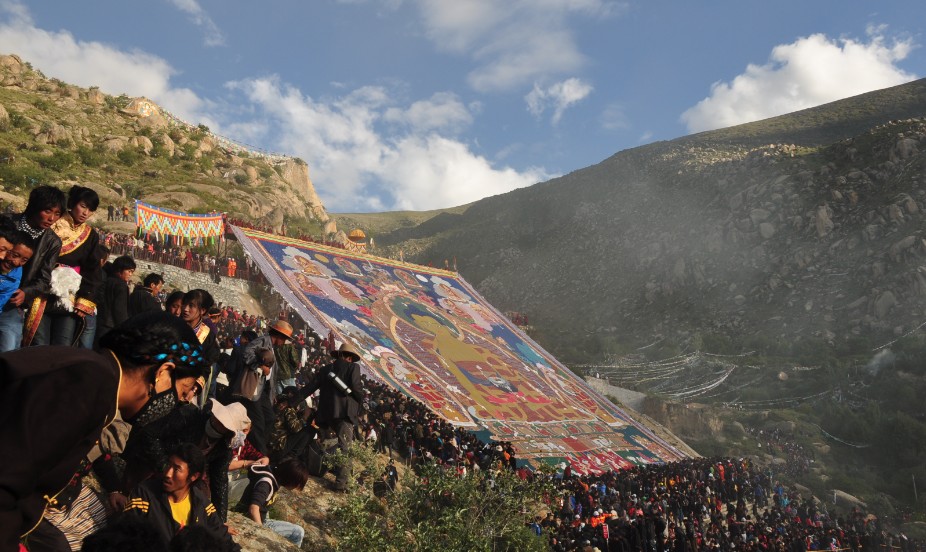
Today, we experience one of the most anticipated days of the Tibetan calendar, joining thousands of pilgrims and local families for the opening celebrations of the Shoton Festival. In the morning, we head to Drepung Monastery, on the outskirts of Lhasa, where thousands of pilgrims from across Tibet gather to witness the spectacular unveiling of the Great Buddha: an enormous 500 m² thangka depicting Shakyamuni Buddha, unfurled across the mountainside amid the sounds of ceremonial horns, prayers and offerings of incense. This extraordinary ceremony is one of the most significant religious events of the year. Founded in 1416, Drepung was once the largest and most powerful monastery in Tibet, housing over 7000 monks. Along with Ganden and Sera, it is one of the three great monastic universities of the Gelug school of Tibetan Buddhism, also known as the Yellow Hat School. Drepung was also the residence of the early Dalai Lamas before the construction of the Potala Palace. In the afternoon, we visit Norbulingka, the former summer palace of the Dalai Lamas, established in the 18th century during the reign of the Seventh Dalai Lama. During the festival, its beautiful gardens become the heart of the celebrations, with traditional Tibetan opera performances (Lhamo), music and countless Tibetan families gathering beneath the trees to enjoy picnics and share food. A memorable day offering a unique insight into Tibetan spirituality, living traditions and festive culture. Overnight in Lhasa.SHOTON FESTIVAL 2028
The Shoton Festival, also known as the Yoghurt Festival, is the most important celebration of the Tibetan summer and one of the most significant religious and cultural events in Lhasa. Traditionally beginning on the 30th day of the sixth month of the Tibetan lunar calendar, this centuries-old festival marks the end of the monks’ summer meditation retreat. Its name derives from two Tibetan words: Sho, meaning yoghurt, and Ton, meaning banquet or feast.The origins of the festival can be traced back to the 11th century and are traditionally associated with the great Buddhist master Atisha, who travelled to Tibet to help revive Buddhism. According to local tradition, villagers offered him yoghurt during the summer months in exchange for blessings and prayers for the protection of their livestock. Over time, this custom became associated with the annual summer retreat, during which monks remained inside their monasteries to meditate and avoid harming the small creatures that emerge during the warmer months. At the end of their retreat, local people welcomed the monks with offerings of homemade yoghurt, giving rise to the Shoton Festival.
Originally a religious observance, Shoton gradually evolved into a major public celebration. During the reign of the Fifth Dalai Lama in the 17th century, traditional Tibetan opera performances were introduced at Drepung Monastery, initially for monks and invited members of the nobility. Later, following the establishment of Norbulingka as the summer palace of the Dalai Lamas in the 18th century, these performances moved to its gardens and became an important part of the celebrations enjoyed by the wider population.
Today, the Shoton Festival combines ancient Buddhist rituals with a week of colourful festivities. Its two main highlights are the spectacular unveiling of a giant Buddha thangka at Drepung Monastery, where thousands of pilgrims gather to pay homage, and the traditional Tibetan opera performances (Lhamo) held in the gardens of Norbulingka. Families from across Lhasa gather beneath the trees to enjoy picnics, share food and celebrate together.
With its unique combination of Buddhist devotion, traditional performing arts and lively popular festivities, the Shoton Festival offers an extraordinary opportunity to experience Tibetan culture and witness Lhasa at its most vibrant.
August 21st, 2028.
Day 20: Tibet departure
Enjoy your final hours in Tibet exploring Lhasa at your own pace before your guide and driver transfer you to the airport for your onward flight. End of our services.Please contact us for information about extending your stay in Tibet.
Book during year 2027 and we guarantee the lowest tour rates for you.
Shoton Festival takes place on August 20th, 2028, in Lhasa. This is a special time to experience one of Tibet’s most important religious and cultural celebrations. As we do every year, we are organising a special 20-day journey for this occasion, starting on August 2nd.
Our journey takes us across the Tibetan Plateau, exploring some of Tibet’s most important monasteries, visiting the North Face of Mount Everest and completing the sacred three-day pilgrimage kora around Mount Kailash, the most sacred mountain in Asia. Along the way, we will also discover the ancient Kingdom of Guge and visit the holy lakes of Manasarovar and Namtso.
We will return to Lhasa in time for the Shoton Festival celebrations on August 20th, joining thousands of Tibetan pilgrims at Drepung Monastery for the spectacular unveiling of the giant Buddha thangka, followed by traditional Tibetan opera performances and festivities in the gardens of Norbulingka Palace. Our journey concludes on August 21st.
All participants are responsible for their own travel arrangements to Lhasa. The maximum group size is 16 people, and transportation varies according to the number of participants.
FULL RATE: 3400 USD per person.
– Early booking: 2995 USD per person if booked before April 1st, 2028.
– Single room supplement: 830 USD.
– Early arrival or late departure options available.
The tour includes all necessary Tibet travel permits, an experienced English-speaking Tibetan guide, accommodation as described in the itinerary, transportation, entrance fees, environmental protection fees, porters during the Mount Kailash Kora and a welcome dinner.
This is an original itinerary designed by us after many years of experience and excellence of our guides who have been leading hundreds of our now beloved friends from all over the world. Please, check TripAdvisor, Facebook and Lonely Planet Forum for their reviews.
Please, contact us for further details. You can also check our upcoming departures if these dates don’t fit your travel plans. You can also book your space the following year 2029 Shoton Festival & Mt. Kailash Pilgrimage Kora Grand Tour.
The Shoton Festival traditionally begins on the 30th day of the sixth month of the Tibetan lunar calendar. Please confirm the tour dates with us before making your travel arrangements.
These are the planned dates for the upcoming years:
Year 2029: Shoton Festival on August 10th. Tour dates: August 8th–27th.
Year 2030: Shoton Festival on August 28th. Tour dates: August 10th–29th.
Price varies according to the number of people in your group, category of hotel, transportation and other services you request. Please contact us with these important details first.
Consulte salidas especiales al Monte Kailash con el único español residente en Tíbet.


Tripadvisor Reviews

Reliable tibetan company
